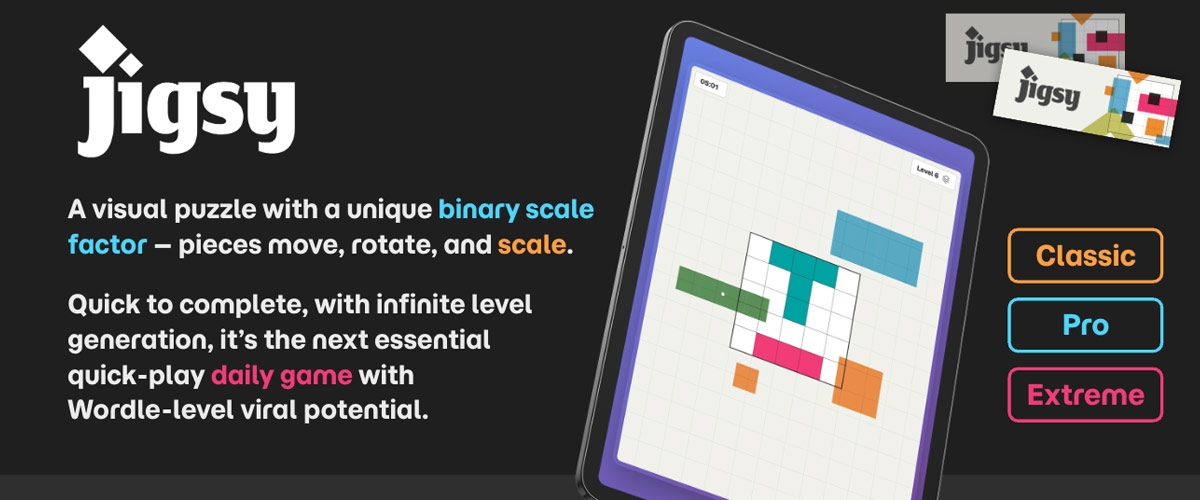
There’s a moment, somewhere around level three of Jigsy, when something clicks.
You’ve been trying to fit an awkward L-shaped piece into the remaining gap, rotating it, nudging it left and right. Then you realise: what if it’s the wrong size? You pinch the piece, it snaps to double its dimensions — and suddenly the entire board resolves. The gap closes perfectly. That’s the scaling mechanic. And once you’ve felt it, no other puzzle quite fills the same space.
Jigsy launched on 14 November 2025. It’s a daily spatial reasoning puzzle — free, browser-based, no app required. At its core, the premise is simple: drag, rotate, and arrange polyomino pieces to fill a grid. But there’s a twist that changes everything. Each piece can be scaled — toggled between its base size and double — and that single added dimension transforms what would otherwise be a familiar tiling puzzle into something genuinely new.
Where It Came From
The seed of the idea goes back to the original iPad launch in 2010. Two-finger gestures — pinch, expand, rotate — felt like they were waiting for a puzzle mechanic to inhabit them. I sketched a concept, put it in a drawer, and left it there for fifteen years.
What eventually revived it was a conversation with a dyslexic friend who was frustrated that virtually every popular daily puzzle — Wordle, Connections, Spelling Bee — is built around language. She wanted something spatial and visual, something that worked the same whether you were in Bath or Bangkok. That conversation, combined with the emergence of AI coding tools, finally gave me the means to build it properly.

The early versions were tested in my coworking office in Bath — colleagues becoming unwitting playtesting subjects, their confusion and occasional delight shaping what Jigsy became. The feedback was clear: the scaling mechanic was unlike anything they’d encountered, but it needed careful onboarding. That’s why the ten-level challenge exists: a gentle ramp from “oh, I just drag pieces” to “wait — I need to think about which pieces to scale first.”
The Mathematics of Scaling
Here’s where it gets interesting — and where Jigsy departs from every polyomino puzzle that came before it.
Standard tiling puzzles operate in a fixed solution space. You have n pieces of fixed sizes, and you’re counting the arrangements that tile a given region. The combinatorics are well understood, the literature is extensive, and the puzzle design challenge is essentially one of curation.
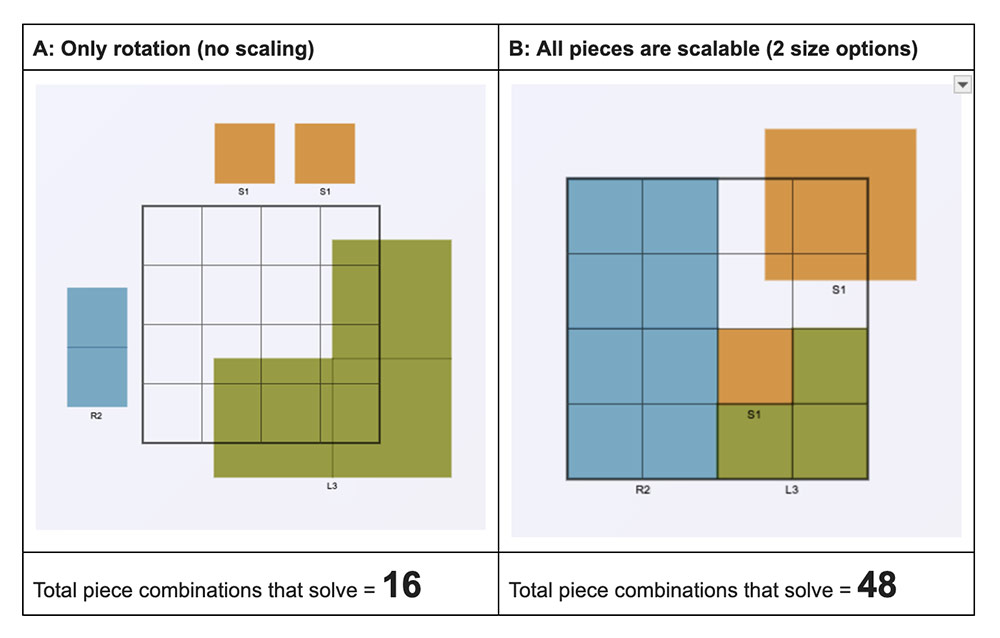
Jigsy adds a single binary choice to each piece: small or large. Each piece can be played at 1× or 2× its base dimensions. That sounds modest. The effect on the solution space is not.
Consider a four-piece puzzle. In a standard tiling puzzle — rotation permitted, no scaling — there are 16 valid piece combinations. Add the scaling dimension, where all four pieces can independently take either size, and that number jumps to 48: a 3× increase from a single binary toggle per piece. Add two more pieces, and the multiplier reaches 21× — a seven-fold amplification compared to the four-piece case. This isn’t linear growth.
What this means in practice is that Jigsy puzzles at the same visual “size” can vary enormously in depth. A six-piece Classic puzzle and a six-piece Extreme puzzle aren’t just harder and easier versions of the same thing — they’re exploring different regions of a much larger mathematical space. The scaling mechanic doesn’t add variety on top of a familiar structure. It fundamentally changes the structure.
I’ve searched extensively for any prior art — digital or physical — that uses scaling as a gameplay mechanic in a tiling puzzle. There isn’t any. One collaborator working through the design with me put it rather grandly: in a landscape dominated by Candy Crush clones and Wordle variants, the scaling polyomino mechanic is arguably the most inventive new contribution to the puzzle genre since the middle of the last century. I’m not quite bold enough to say that myself. But I’m not going to pretend I disagree with it either.
What It Looks Like in Practice
Jigsy runs as a daily challenge — one new puzzle each day, across three difficulty variants: Classic, Pro, and Extreme. There’s also a ten-level prize draw challenge that introduces the mechanics progressively.
The game works on any browser, but the best experience is on a large touchscreen — tablet especially — where the two-finger pinch-to-scale gesture feels exactly like it was always supposed to. Mobile has recently received a significant UI overhaul: zoom in and out of the play area, more responsive gestures, and improved visual clarity.
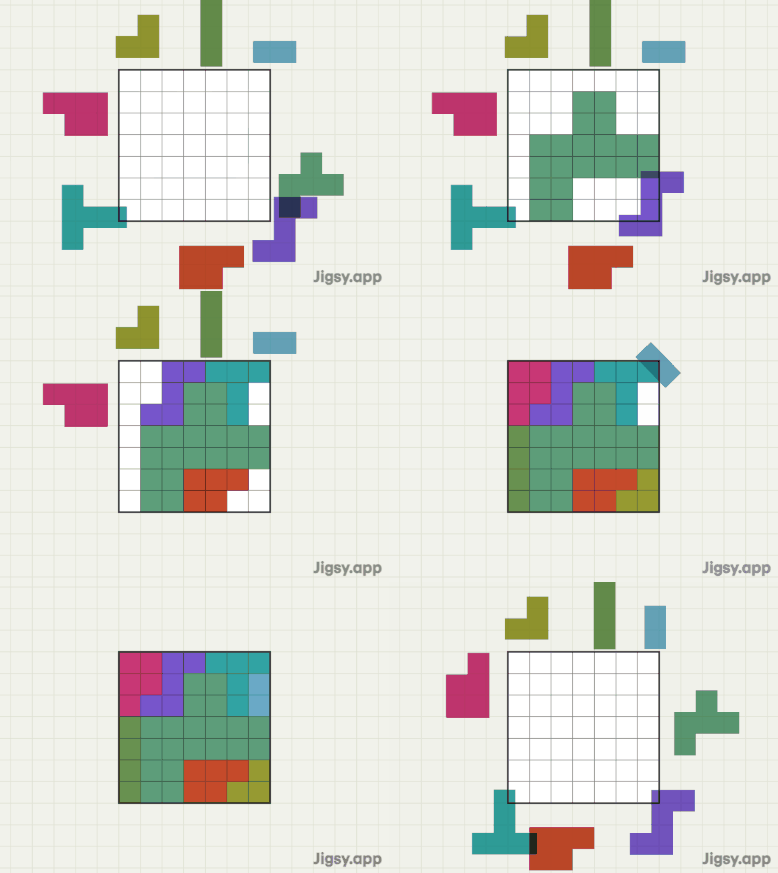
New features include hints for when you’re genuinely stuck, a give up option that reveals the solution, and — perhaps most satisfying — animated solution replays for yesterday’s puzzle, so you can watch the intended solve play out piece by piece.
How It’s Been Received
Jigsy has quietly built a base of around 150–200 puzzle completions per day, with over 20,000 total completions since launch. Growth has been organic and steady.
The puzzle has been featured in The Aperiodical — a respected mathematics and puzzle publication — where the scaling mechanic’s mathematical properties attracted genuine interest from the recreational maths community. It also appeared on Futility Closet and MetaFilter, where a small community played it and debated the implications of multiple distinct solutions — a sign that the right kind of people are engaging with it seriously.
Outside the puzzle world, Jigsy was selected as a finalist in the Algorand Foundation Startup Challenge — chosen from 75 submitted projects — placing in the top ten and receiving a $5,000 prize. Read more about that here.
What’s Coming Next
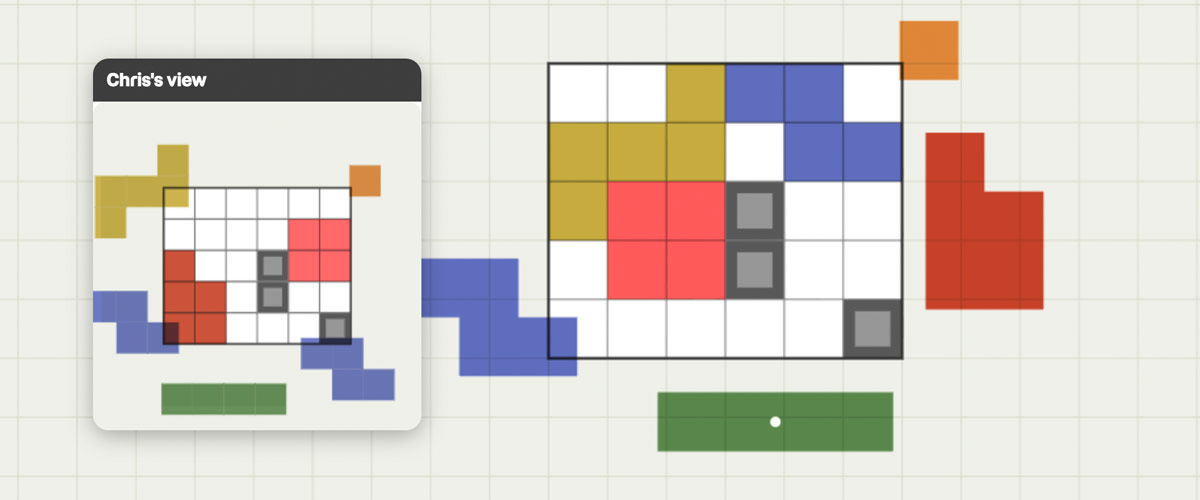
Multiplayer head-to-head mode is in development — a real-time race where two players solve the same puzzle simultaneously, with a picture-in-picture view of your opponent’s progress. A visual level designer will eventually let players design and share their own Jigsy puzzles. Leaderboards, community boards, and deeper difficulty algorithms are all on the list.
Longer term, there’s genuine interest in using Algorand blockchain integration for premium content and micropayments — a play-to-earn layer built on top of the puzzle mechanic. The infrastructure is there; the timing is a question of when the tooling matures.
Try Jigsy
Free, no account required, works on any device. Start with the ten-level challenge — it takes about twenty minutes.
Start the Challenge Play Today’s Puzzle