“The history of the subject entails nothing short of the actual story of the beginnings and development of exact thinking in man.”— Henry Ernest Dudeney, Amusements in Mathematics, 19171
Every tiling puzzle asks the same question: does it fit? You have some pieces and a space, and the job is to fill the space exactly, with no gaps and no overlaps. A child can understand the question in seconds. It turns out to be one of the deepest questions in mathematics. Some versions of it are provably among the hardest problems a computer can be asked to solve. Others are provably impossible to settle by any algorithm at all.
This essay is a natural history of that question. It runs from a square of bone pieces described by Archimedes to plastic trays filmed for TikTok, and it argues that the genre has evolved the way organisms do. Rarely does anything new appear from nowhere. Instead, one rule changes at a time: which shapes the pieces may take, which grid they live on, how many dimensions they occupy, who (or what) does the solving, and what the solver is allowed to do to a piece before putting it down. Every famous tiling puzzle is a mutation of one of these rules, and it survived because the change opened up new mathematics.
We have a stake in this story, which we should declare at the start. Jigsy, the daily puzzle that lives on this site, changes a rule that has stayed almost untouched for two thousand years. We’ll get to that near the end, and keep it in proportion. Most of what follows is about the giants: Archimedes, Dudeney, Golomb, Gardner, Conway, Knuth, and a retired print technician from Yorkshire.
1. The bone-fight: Archimedes’ square
The oldest tiling puzzle we can name nearly vanished. Its text survives in an Arabic version and in the Archimedes Palimpsest, a tenth-century Byzantine copy of Archimedes that was scraped off in the thirteenth century so the parchment could be reused for a prayer book. The puzzle cuts a square into fourteen polygons. The Roman poet Ausonius, writing in the fourth century AD, gives its name: “quod Graeci ostomachion vocavere”, “which the Greeks called ostomachion”. The name joins osteon, bone, with machē, fight.2 So the pieces were bone, and putting them together was a fight. Every puzzler since has recognised the feeling.
Classical writers say the pieces were rearranged into pictures: elephants, trees, ships. So in its first role the Stomachion worked like a tangram, a set for making silhouettes. The surviving Greek fragment, however, points to something more mathematical. In 2003 the historian Reviel Netz argued that Archimedes was counting: he wanted the number of ways the fourteen pieces could be put back together as a square. If Netz is right, the Stomachion is a contender for the oldest problem in combinatorics.
The modern answer came from a computer. Fan Chung, Persi Diaconis, Susan Holmes and Ronald Graham counted 17,152 arrangements, and Bill Cutler confirmed the figure by exhaustive search. Once you merge arrangements that differ only by rotating or reflecting the whole square, or by swapping the two pairs of identical pieces, 536 remain.24 (For the numerically curious, 536 × 8 × 2 × 2 = 17,152.) So the first tiling puzzle we know of was already asking the question that would dominate its descendants: not only can it be done, but in how many ways?
2. Seven boards of wisdom
After Archimedes the record goes quiet for a long time. When dissection puzzles come back, they come from East Asia. The tangram is a square cut into seven pieces: five isosceles right triangles in three sizes, a square and a parallelogram. It reached the West from China around 1800 and set off a genuine craze: by 1817 tangram books were selling in London, Paris and Copenhagen.5 A century later Sam Loyd, the great American puzzlist and an equally great self-promoter, published The Eighth Book of Tan (1903). It invented a 4,000-year history for the puzzle. Dudeney later printed the verdict of the Chinese scholars he consulted: “The man Tan, the god Tan, and the Book of Tan are entirely unknown to Chinese literature, history or tradition.”5
Japan had its own version earlier. The Sei Shōnagon Chie-no-Ita (“Sei Shōnagon’s wisdom boards”) appeared in print in 1742. It is named after the Heian court writer, although there is no evidence the puzzle existed in her lifetime. Like the tangram, its seven pieces are built from sixteen identical right isosceles triangles. It turns out to be the more expressive of the two. In 1942 Fu Traing Wang and Chuan-Chih Hsiung proved that the tangram can form exactly 13 convex shapes. Eli Fox-Epstein and Ryuhei Uehara later showed that the Sei Shōnagon set forms 16.6 Their paper also contains a lovely aside: “Even in Japan, the tangram is more popular than Sei Shōnagon Chie no Ita, though Sei Shōnagon Chie no Ita is common enough to have been made into ceramic dinner plates.”6
These are dissection puzzles: one fixed set of pieces, many target shapes. The mutation that turned them into modern tiling puzzles came next. Instead of a fixed set of arbitrary pieces, mathematicians began to ask about every shape that a simple rule allows.
3. The puzzlists: Dudeney, Loyd and a broken chessboard
The late Victorian and Edwardian decades were the golden age of the newspaper puzzle. Two men dominated them. Sam Loyd worked in America. Henry Ernest Dudeney (1857–1930) worked in England, first under the pseudonym “Sphinx” and then for twenty years in The Strand Magazine. The two collaborated for a while, and then fell out when Dudeney accused Loyd of publishing his puzzles under Loyd’s own name.7 Dudeney produced the most famous hinged dissection of all, the Haberdasher’s Puzzle (1902), which turns an equilateral triangle into a square. He also wrote a sentence that could serve as the motto of this whole essay:
“Every man, woman, and child who tries to ‘reason out’ the answer to the simplest puzzle is working, though not of necessity consciously, on mathematical lines.”— Dudeney, Preface to Amusements in Mathematics (1917)1
For our story, the important puzzle is in The Canterbury Puzzles (1907). In The Broken Chessboard a chessboard has been smashed into thirteen pieces: one 2 × 2 square and twelve pieces of five squares each, every one a different shape. Those twelve are the complete set of what we now call pentominoes. David Singmaster’s chronology of recreational mathematics lists it as the first use of all twelve.8 Dudeney had no name for them yet. He just knew that a family of shapes defined by a simple rule (“five squares, joined edge to edge”) made a richer puzzle than any hand-picked set.
The same chronology records earlier hints. A 1749 French compendium, Les Amusemens, has the first known “quadrisection of an L-tromino”: an L of three squares cut into four smaller copies of itself.8 Keep it in mind, because we will come back to it. In 1893 Professor Hoffmann (Angelo Lewis) published the Diabolical Cube in Puzzles Old and New. Its six flat polycubes, of sizes two to seven, assemble into a 3 × 3 × 3 cube, and it is apparently the oldest puzzle of that kind.9 Between 1937 and 1957 the readers of Fairy Chess Review kept setting each other dissection problems that are polyomino puzzles in everything but name.10 Two Dudeney inventions matter later on. One is Mrs Perkins’s Quilt, which asks for a square patchwork cut into the fewest smaller squares, of differing sizes.11 The other is the 1910 tangram debunking already quoted. Both show his habit of finding mathematics where others saw only amusement.
4. Naming the animals: Golomb and Gardner
In 1953 a 21-year-old Harvard graduate student named Solomon W. Golomb (1932–2016) gave a talk to the university’s mathematics club and coined a word: polyomino, a back-formation from “domino”. His 1954 paper in the American Mathematical Monthly, “Checker Boards and Polyominoes”, set out the subject. His 1965 book Polyominoes made it a discipline.1012 Golomb’s day job was elsewhere. He invented the shift-register sequences that sit inside radar, deep-space communication and every mobile phone, and he was later awarded the US National Medal of Science. Polyominoes were his hobby, and they leaked into the world just as quietly as his engineering did. Shortly before he died he said: “I’m proud that I’ve lived to see… so many of the things that I’ve worked on being so widely adopted that no one even thinks about where they came from.”13
Golomb named the animals. Martin Gardner (1914–2010) let them loose. Gardner’s Mathematical Games column in Scientific American began in January 1957 and ran for a quarter of a century. It introduced polyominoes to a general readership along with flexagons, Penrose tiles, the Game of Life and public-key cryptography.14 Gardner was not a professional mathematician, and he never pretended otherwise: “I just play all the time and am fortunate enough to get paid for it.”14 Conway called him “the most learned man I have ever met”. For a generation of mathematicians, the column was where the subject first felt like play.
Pentominoes also made recreational mathematics one of the first uses of electronic computers for combinatorial search. In 1958 Dana Scott wrote what is often cited as an early backtracking program. It found that the 8 × 8 board with a 2 × 2 hole in the centre has exactly 65 pentomino solutions. Two years later C. B. and Jenifer Haselgrove counted the 6 × 10 rectangle at exactly 2,339 solutions.12 Arthur C. Clarke, who was so taken with the puzzle that he built a plot point of Imperial Earth (1975) around it, summed up its appeal: “That a jigsaw puzzle consisting of only 12 pieces cannot be quickly solved seems incredible, and no one will believe it until he has tried.”15
The power of colouring
Golomb’s other great contribution was a style of proof. Take the mutilated chessboard, posed by the philosopher Max Black in 1946. Remove two opposite corners from a chessboard. Can the remaining 62 squares be covered by 31 dominoes? You could search for a long time. Or you could notice that the two missing corners are the same colour. The board now has 32 squares of one colour and 30 of the other, while every domino covers one of each. So it is impossible, and the proof takes one line.16
Colouring and parity arguments became the standard tool of the trade. They show which configurations are impossible, they speed up computer searches, and (as we’ll see) they explain why some modern variations feel the way they do. Ralph Gomory later proved the reverse: remove any two squares of opposite colours and a domino tiling always exists.16 When the parity check passes, it is the only obstruction.
One more piece of descent before we move on. In the mid-1980s a Soviet researcher named Alexey Pajitnov bought a pentomino set, played with it at work, and decided to turn it into a computer game. He programmed it on an Elektronika 60, a Soviet clone of the PDP-11, and simplified the pieces from five squares to four. The result was Tetris.17 It may be the most widely played tiling puzzle ever made, and it descends directly from Golomb.
5. Into the third dimension
The next mutation added a dimension. In 1933 the Danish polymath Piet Hein was sitting in a lecture on quantum mechanics given by Werner Heisenberg. During it, he worked out that the seven irregular shapes made of at most four cubes (the ones with an inside corner) add up to 27 cubes, exactly a 3 × 3 × 3. This is the Soma cube. Gardner covered it in 1958, and John Conway and Michael Guy listed all 240 of its solutions by hand.18
Packing puzzles in three dimensions turned out to be the natural home for parity arguments. The Dutch architect-designers Jan Slothouber and William Graatsma spent decades exploring the cube as a design module. They ran their “Centre for Cubic Constructions”, which existed, as one account puts it, solely in their minds and at a PO box in Heerlen, and they published Cubics in 1970.19 Their puzzle asks you to pack six 1 × 2 × 2 blocks and three single cubes into a 3 × 3 × 3 box. The solution is unique. A parity argument forces the three small cubes onto a body diagonal: each 1 × 2 × 2 block fills an even number of cells in any 3 × 3 slice it crosses, and every slice has nine cells, an odd number.20
John Horton Conway (1937–2020) scaled the idea up. His “blocks-in-a-box” asks for thirteen 1 × 2 × 4 blocks, one 2 × 2 × 2, one 1 × 2 × 2 and three 1 × 1 × 3 rods to be packed into a 5 × 5 × 5 cube. It looks hopeless until you see that the three rods must sit so that exactly one of them crosses each 5 × 5 × 1 slice of the cube.21 With Elwyn Berlekamp and Richard Guy, Conway wrote the puzzle up in Winning Ways for Your Mathematical Plays, and it is the clearest demonstration that a good packing puzzle is really a theorem in disguise. The American designer Stewart Coffin, meanwhile, spent fifty years turning these ideas into wooden puzzles of extraordinary craft.
6. Other grids: triangles, hexagons and the periodic table
If you can make shapes from squares, why not from equilateral triangles, or hexagons? In 1961 the mathematician and puzzle columnist Thomas H. O’Beirne, writing in New Scientist, proposed the word polyiamond, a joke back-formation from “diamond”, which is two triangles joined at their bases.22 There are 12 hexiamonds (six triangles each), and they make a classic set. They pack a 6 × 6 rhombus in 156 ways, a 4 × 9 parallelogram in 74, and a 3 × 12 parallelogram in none.23 Hexagons give the polyhexes, and the family keeps growing: polykites, polydrafters (built from 30-60-90 triangles), polyaboloes, polycubes, even four-dimensional polytesseracts.24
The variety is now large enough to need a taxonomy, and two people have taken that on. Kate Jones of Kadon Enterprises has spent decades making polyform sets in laser-cut acrylic and hardwood. At the 2021 Celebration of Mind run by the Gathering 4 Gardner she presented a Periodic Table of Polyform Puzzles that sorts the whole field by base cell and family size, in rhymed couplets, no less. (“It’s like a very condensed book on the subject,” she said of the format.)2526 The British enthusiast behind Abaroth’s World has catalogued hundreds of original polyform problems: tetrahex butterflies, symmetric snowflakes, rectangles with shaped holes, all built on squares, triangles, hexagons and kites.27 Taken together, the two resources show how far the simple rule “join identical cells edge to edge” can be pushed.2829
7. When puzzles became theorems, and programs
Around 1960 the genre split. One branch stayed with the puzzle box. The other went into the foundations of mathematics.
In 1961 the logician Hao Wang asked whether there is an algorithm that can decide, for any finite set of square tiles with coloured edges, whether those tiles can cover the whole plane. In 1966 his student Robert Berger proved there is none: the “domino problem” is undecidable. Along the way Berger built a set of 20,426 tiles that can tile the plane, but only non-periodically.30 Golomb carried the result over to his own creatures in 1970, showing that whether a given set of polyominoes tiles the plane is also undecidable.31 The bound has kept falling. In 2025 Erik Demaine and Stefan Langerman proved it undecidable even for sets of just three polygons.32
Finite puzzles, the kind with a box and a lid, can always be decided in principle, because you can try everything. In practice they are still hard. In 2007 Erik and Martin Demaine proved that jigsaw puzzles, edge-matching puzzles and polyomino packing puzzles are all NP-complete, and that they are essentially the same problem: each can be translated efficiently into the others.33 That has a real-world consequence. In 1999 Christopher Monckton launched the Eternity puzzle, with 209 pieces each made of twelve 30-60-90 triangles, and offered £1 million to the first solver. It was cracked in May 2000 by two Cambridge mathematicians, Alex Selby and Oliver Riordan, with a carefully designed computer search. Selby noted afterwards that “the puzzle was actually significantly easier to solve without enforcing any fixed hint pieces.”34 The general problem is hard. Any particular instance can be easier than its designer thinks.
The computer also changed who writes about puzzles. When Gardner retired, Douglas Hofstadter took over the Scientific American column, and then, from 1984 to 1991, A. K. Dewdney (1941–2024) ran it as Computer Recreations.35 Dewdney was a computer scientist who co-invented the programming game Core War and imagined a two-dimensional universe in The Planiverse. His column marks the moment when “a puzzle” could just as easily mean “a program”. For tiling, the decisive program came in 2000, when Donald Knuth published Dancing Links, an elegant way to run exhaustive search on exact-cover problems. His abstract names the use case outright: “tiling a tray by a fixed set of polyominoes”.36
Then comes one of the best stories in modern mathematics. The puzzle enthusiast Jaap Scherphuis built Knuth’s algorithm into a free program, the PolyForm Puzzle Solver, which handles squares, triangles, hexagons, kites and a dozen other grids.37 In November 2022 David Smith, a retired print technician from Bridlington in Yorkshire, was experimenting with polykites in it. He noticed it producing a tessellation he had never seen before. He cut the shape out of card, kept placing copies, and could not make the pattern repeat. With Craig Kaplan, Joseph Samuel Myers and Chaim Goodman-Strauss he proved that his thirteen-sided “hat” is an aperiodic monotile: a single shape that tiles the plane, but never periodically. This solved the half-century-old “einstein problem”.3830 The hat is made of eight kites, so it is, quite literally, a polyform. A recreational puzzle solver, running an algorithm written for pentominoes, found a shape that mathematicians had sought since the 1960s.
Why this matters for puzzle design. The line between “recreational” and “serious” mathematics in tiling has never held for long. The Special Interest Group of the Mathematical Association of America on recreational mathematics (SIGMAA-Rec) exists precisely “to promote the often-deep mathematics inside the subjects” of games and puzzles, and “to promote recreational mathematics as a serious field of study”.39 Wikipedia’s definition, recreational mathematics as mathematics “carried out for recreation (entertainment) rather than as a strictly research-and-application-based professional activity”, describes a motive, not a level of difficulty.40
8. Pencil, paper and the Japanese tradition
While the West was building computers to solve tiling puzzles, Japan was building a culture of setting them by hand. The great figure of the second half of the century was Nob Yoshigahara (1936–2004), a chemistry graduate turned teacher, columnist and inventor. He wrote more than eighty puzzle books, and his best-known design is Rush Hour, a sliding-block puzzle about moving rectangles around a crowded grid.41 His name turns up again below, among the people who first solved the Partridge puzzle.
In the 1980s the magazine Puzzle Communication Nikoli turned the tiling puzzle into ink. In Fillomino you divide a grid into polyominoes so that each number sits in a region of exactly that many cells, and no two regions of the same size touch.42 In Shikaku you carve a grid into rectangles. In Shakashaka you add black half-square triangles until every remaining white area is a rectangle. That last one, from Nikoli, was proved NP-complete in 2014.43 Here the pieces are invented by the solver rather than handed over, but the underlying question is the same: does it fit?
The Guardian’s puzzle columnist Alex Bellos brought this world to English readers in Puzzle Ninja (2017). The book has more than two hundred grid puzzles by Japanese inventors, most of them little known outside Japan, together with portraits of the setters. Among them is Naoki Inaba, whom Bellos calls “the most prolific inventor of Japanese logic puzzles”.44 His summary of the aesthetic suits this essay well: “When it comes to Japanese puzzles, you don’t have to be square, but it helps!”44
9. The tray on the shelf and the phone in the hand
Tiling puzzles were never really a niche. They are one of the commonest toys on earth. What has changed in the last decade is how they are shared.
Kanoodle, from Educational Insights, is twelve polyomino-like pieces made of fused beads, a small tray, and a booklet of 200-plus starting positions in 2D and 3D. It has sold more than nine million copies.45 It became a TikTok phenomenon largely through one person: Arlene Resendiz, a former maths teacher known as the Kanoodle Queen, whose @silentmath account has well over a million followers. The Kanoodle hashtag has been used hundreds of millions of times.46 Asked why the videos work, she gave the most honest description of puzzle psychology we’ve read: “People like to feel that they can solve something that’s a little difficult.”46 A packing puzzle is ideal short-form video. The goal is visible, the progress is visible, and the last piece clicking home gives the clip its ending.
The big toy brands have noticed. Spin Master’s Rubik’s Gridlock gives you eleven coloured blocks and 88 challenge cards in four difficulty levels. Each card fixes a few “starter” blocks and has exactly one solution.47 Rubik’s has even crossed its own cube with Tetris: the 2025 Rubik’s Tetris Cube is solved by forming the tetrominoes, in their proper colours, on the faces.48 Video games have used the idea for years too. The tetromino “sigil” locks in The Talos Principle (2014) are pure packing puzzles inside a philosophical adventure game.
Notice what these modern products share with Dudeney. They take a classic set of pieces and change one rule: a fixed starter piece, a colour constraint, a third dimension, a twist. That is how the genre has always evolved. So it is worth asking which rule has changed least.
10. The rule that rarely moved: size
Look back over the whole history and something stands out. The pieces have changed shape, grid, number, dimension and colour. The solver has changed from a person to a program and back. But in almost every tiling puzzle, a piece’s size is fixed. You may turn it, flip it, slide it. You may not make it bigger.
Scale has appeared in the literature, but almost always as part of the problem statement, set by the setter, rather than as something the solver controls. The exceptions are a small and fascinating family:
- Rep-tiles. Golomb coined the term, a pun on reptiles, and Gardner popularised it in May 1963. A rep-tile is a shape that can be cut into smaller copies of itself.49 Golomb’s 1964 paper “Replicating Figures in the Plane” set out the theory.50 The L-tromino is rep-4, as is every triangle and every parallelogram. So is the hexiamond known as the sphinx, the only known pentagonal rep-tile. And the 1749 “quadrisection of an L-tromino” mentioned earlier is the earliest rep-tile puzzle we know of.8
- The pentomino triplication problem. Choose any pentomino. Using nine of the other eleven, build a copy three times as large. It can be done for all twelve.5112
- Squared squares and Mrs Perkins’s quilt. Dudeney’s quilt asked for a square cut into the fewest smaller squares. Its pieces vary only in size. Four Cambridge undergraduates (Brooks, Smith, Stone and Tutte) turned the problem into electrical-network theory in the late 1930s, and in 1978 A. J. W. Duijvestijn found the smallest “perfect” squared square: 21 squares, all of different sizes, in a square of side 112. It is now the emblem of the Trinity Mathematical Society.52
- The Partridge puzzle. Take one 1 × 1 square, two 2 × 2 squares, three 3 × 3 squares, and so on up to n of size n × n. Because 1³ + 2³ + … + n³ = (1 + 2 + … + n)², their areas always add up to a square. Robert Wainwright named the puzzle, and the first n that actually works is 8. That case was solved by Bill Cutler, William Marshall, Michael Reid and Nob Yoshigahara.5354
- Similar-copy tilings. George Sicherman’s pages on tiling a polyomino “at scale 2”, and Erich Friedman’s on packing with similar copies, show how far the theme can be pushed as pure problem-setting.5554
In digital games, scaling is everywhere in platformers and first-person puzzles. Superliminal is built around forced perspective, and the 2024 Game Maker’s Toolkit jam took “Built to Scale” as its theme. It is rarer in tiling puzzles. We found two small jam entries from that 2024 event. In Gridfill you drag blocks that “scale up in different ways” to fill a grid of dots. The designer of Built To Expand described it candidly: “this concept is nothing new … The catch here, however, is that the puzzle pieces scale / expand.”56 Both are worth a look. Both show that the idea is in the air.
11. Size as a choice
Jigsy grew out of a sketch made when the first iPad appeared in 2010. Two-finger pinch and rotate gestures seemed to be waiting for a puzzle that needed them. The game launched in November 2025.57 Its rule change is simple to state. Every piece is a polyomino that the player can set either to its base size (1×) or to its exact double (2×), whenever they like. The doubled piece is the original with every cell replaced by a 2 × 2 block, which is the rep-4 relationship from the list above, used here as a move rather than as a puzzle. Then the job is the usual one: fill the grid.
We have looked hard for an earlier tiling puzzle, physical or digital, built around a player’s free choice between a polyform and its exact double, and haven’t found one. We would honestly like to hear of one. What we can describe more confidently is what the choice does to the mathematics, because it does something rather specific.
An arithmetic problem hidden inside a geometry problem
Say the pieces have areas a₁, …, aₙ and the grid has area A. Doubling a piece multiplies its area by four, so whichever set S of pieces you double must satisfy
a₁ + … + aₙ + 3 · Σi∈S aᵢ = A.
That is a subset-sum problem, one of the classic NP-complete problems, sitting inside a packing problem, another one. Before any piece goes down, the solver has to decide which pieces are “big”, and the numbers alone usually leave several candidate answers. Take four pieces of areas 1, 1, 2 and 3 and a 4 × 4 grid. The base areas sum to 7, so the doubled pieces must account for 9 more, which means their base areas must sum to 3. That can be done three ways: double the 3-cell L, or double the domino with either single square. Geometry then decides which of those candidates actually tile. An early Jigsy design note counted the effect on one small puzzle: 16 solving combinations with rotation alone, 48 once doubling was allowed.57
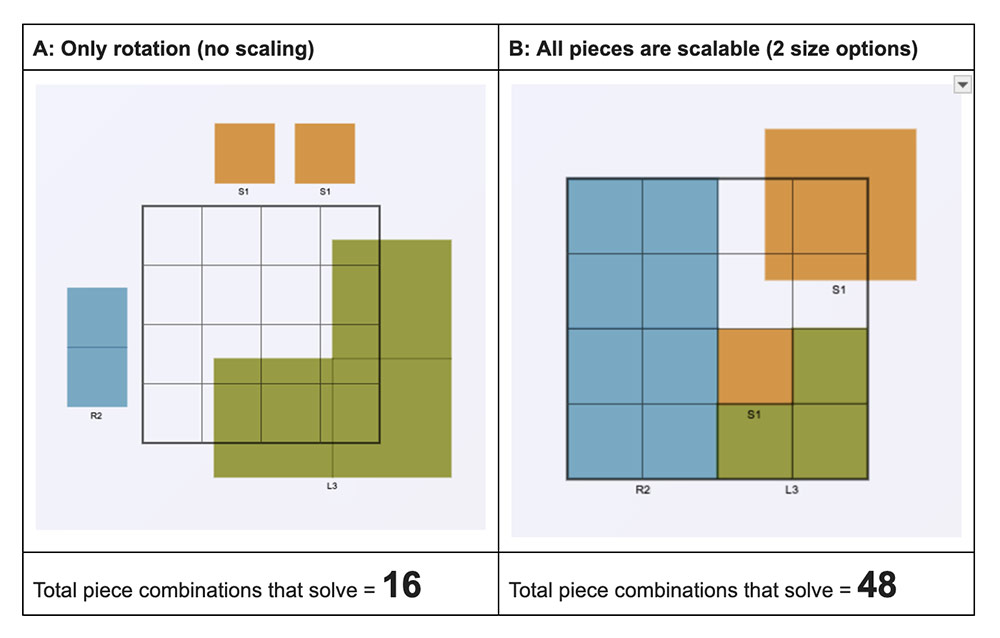
From an early Jigsy design note: the same four pieces solve a 4 × 4 grid in 16 ways using rotation alone, and 48 when each piece can be doubled.
Doubling switches off the chessboard
Now bring back Golomb’s colouring. Colour the grid like a chessboard. A piece at 1× usually covers unequal numbers of light and dark squares. The T-tetromino, for instance, always covers three of one colour and one of the other. At 2×, every original cell becomes a 2 × 2 block containing two light squares and two dark ones. So a doubled piece is always colour-neutral. If the grid itself is unbalanced (say an odd-by-odd rectangle, or one with blocked cells), only the undoubled pieces can make up the difference. Players work this out without ever putting it into words. When the board is lopsided, the small pieces have to go in the awkward corners.
12. Triangles: when cells have a direction
The square grid is the easy case, because every cell is the same. The triangular grid is not. Half its cells point up and half point down, and the two kinds alternate. We wrote about the practical side of this in an earlier post.58 Here is the mathematical side, because it is where scaling becomes most interesting.
On a chessboard, “colour” is paint. Slide a piece one square and its colour count flips. On a triangular grid, “up” and “down” are geometry. Sliding a polyiamond around the grid never changes how many of its cells point up. Only rotation does: a turn of 60° (or any odd multiple of it) swaps every up for a down, while turns of 120° leave them alone. So each piece carries a fixed signed imbalance, up-cells minus down-cells, and its orientation decides the sign. That is why the hexiamond in the rhombus above can’t go just anywhere: up-triangles must land on up-cells.
Now double a piece. A doubled up-triangle is made of three up-triangles around a single inverted triangle in the middle, and the centre of the big triangle sits exactly on that inverted cell. A doubled down-triangle is the mirror image. So a piece with u up-cells and d down-cells becomes, at 2×, a piece with 3u + d up and u + 3d down, and its imbalance becomes
(3u + d) − (u + 3d) = 2(u − d).
On squares, doubling cancels a piece’s colour imbalance. On triangles, doubling doubles it. That is a real structural difference between the two versions of the game, not just a difference in look. A hexagonal board has equal numbers of up and down cells, so the signed imbalances of all the pieces, after rotation and scaling, must sum to zero. A triangular board of side n has n more up-cells than down-cells, so the pieces must net exactly n. The orientation bookkeeping, which the square game doesn’t have, is the main reason Jigsy Triangles feels so different in the hand.
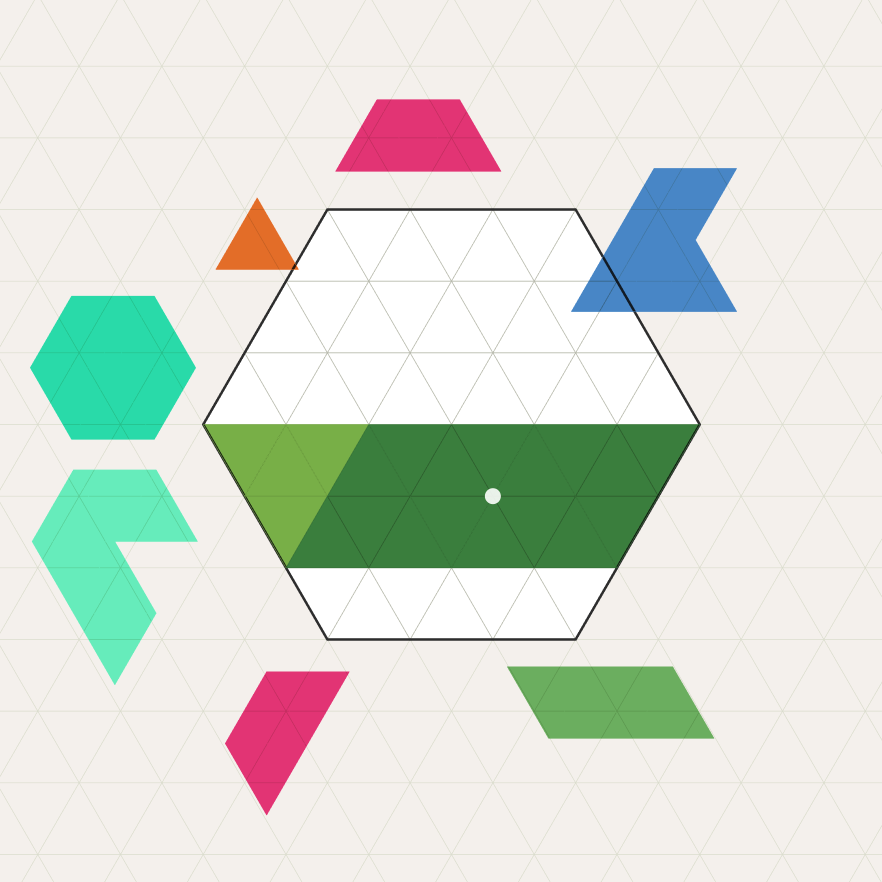
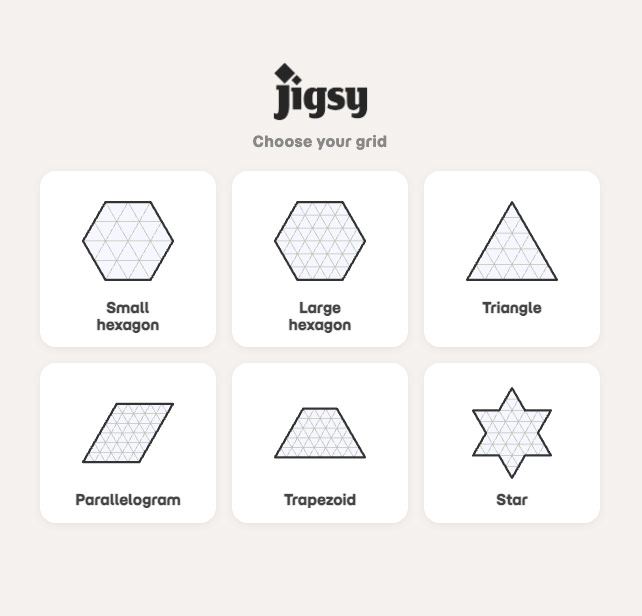
Board shapes in Jigsy Triangles. The triangle board is the only one here whose up and down cells don’t balance, so its pieces must net a fixed surplus.
And why there is no hexagonal version
The obvious next question is whether the same could be done with polyhexes. It can’t, at least not in this form, and the reason ties the whole story together. Jigsy’s doubling works because a doubled cell is exactly four cells of the same grid: squares and triangles are both rep-4 tiles. Of the three regular polygons that tile the plane, the hexagon is the only one that is not a rep-tile. A hexagon at twice the size cuts straight through its neighbours.
So the doubling idea from rep-tile theory, which goes back through Golomb and Gardner to that 1749 L-tromino, picks out exactly two of the three regular grids. Jigsy uses both.
13. Back to Archimedes
We started with a mathematician who, two thousand years ago, may have been counting the ways fourteen pieces of bone could fill a square. It is a good place to finish, because counting is still where the open questions are. Here are three that interest us. We don’t know the answers, and we’d be glad to hear from anyone who does.
1. How much does geometry prune arithmetic? For random piece sets and rectangular grids, what fraction of the size choices that pass the subset-sum test actually tile? Does it fall off sharply with grid size, as you might expect, or does doubling (which turns pieces into chunky, rectangle-friendly blocks) keep it surprisingly high?
2. How hard is the general problem? Polyomino packing is NP-complete with fixed sizes, and subset-sum is NP-complete on its own. It seems very likely that “packing with a free choice of 1× or 2×” is NP-complete too, but we haven’t seen a proof, and the reduction is less obvious than it looks: the extra freedom could in principle make some instances easier.
3. What happens to parity on triangles? On the triangular grid, doubling multiplies a piece’s orientation imbalance by two. Which hexagonal and triangular boards are therefore impossible for particular piece sets, and can those obstructions be catalogued as neatly as the colouring arguments on squares?
The genre has lasted because each generation found a rule to change and a new piece of mathematics behind the change. Dudeney changed the piece set, Golomb the definition, Hein the dimension, O’Beirne the grid, Nikoli the medium, Knuth the solver, and the TikTok solvers the audience. Changing the size of the pieces, and handing that choice to the player, is a small addition to a long line. We think it is a real one.
If you’d like to test that for yourself, today’s puzzle is on the front page. It takes a few minutes, and the first time a piece doubles and drops into a gap you had written off is the moment this whole essay has been about. The triangular version is here. Bring a sense of direction.
Dudeney would have recognised the feeling. Everyone who tries to reason out a tiling puzzle, he said, is working on mathematical lines. Most of them just call it fitting things together.
Try the scaling grid
A new Jigsy puzzle every day: free, in the browser, and done in a few minutes.
Play today’s puzzle Try Jigsy TrianglesNotes and sources
- H. E. Dudeney, Amusements in Mathematics (1917), Preface. Project Gutenberg. www.gutenberg.org/ebooks/16713
- “Ostomachion”, Wikipedia: Archimedes Palimpsest, Ausonius, and the 17,152 count by Chung, Diaconis, Holmes and Graham, confirmed by W. H. Cutler. en.wikipedia.org/wiki/Ostomachion
- “Archimedes’ Stomachion: Construction”, The Archimedes Home Page, NYU. Our Figure 2 is redrawn from this construction. math.nyu.edu/Archimedes/Stomachion/construction.html
- E. W. Weisstein, “Stomachion”, MathWorld: Cutler’s 536 distinct solutions (November 2003). mathworld.wolfram.com/Stomachion.html
- “Tangram”, Wikipedia: Western craze c. 1817, Loyd’s Eighth Book of Tan (1903), Dudeney’s correspondents, Wang & Hsiung (1942). en.wikipedia.org/wiki/Tangram
- E. Fox-Epstein and R. Uehara, “The Convex Configurations of ‘Sei Shōnagon Chie no Ita’ and Other Dissection Puzzles”, arXiv:1407.1923. arxiv.org/abs/1407.1923
- “Henry Dudeney”, Wikipedia. en.wikipedia.org/wiki/Henry_Dudeney
- A chronology of recreational mathematics (after David Singmaster): entries for Les Amusemens (1749) and Dudeney’s Canterbury Puzzles (1907). www.cs.purdue.edu/homes/gnf/chr-rmath.html
- “Diabolical cube”, Wikipedia: Hoffmann, Puzzles Old and New (1893). en.wikipedia.org/wiki/Diabolical_cube
- “Polyomino”, Wikipedia: history, Fairy Chess Review, Golomb (1953), enumeration. en.wikipedia.org/wiki/Polyomino
- Dudeney, “Mrs. Perkins’s Quilt”, in Amusements in Mathematics (1917), via Wikisource. en.wikisource.org/wiki/Page:Amusements_in_mathematics.djvu/59
- “Pentomino”, Wikipedia: Dudeney (1907), Golomb, Dana Scott (1958, 65 solutions), the Haselgroves (1960, 2,339 solutions), the triplication problem, Arthur C. Clarke. en.wikipedia.org/wiki/Pentomino
- “Solomon Golomb (1932–2016)”, The Aperiodical. aperiodical.com/2016/05/solomon-golomb-1932-2016/
- “Martin Gardner”, Wikipedia: column history and quotations. en.wikipedia.org/wiki/Martin_Gardner
- “Pentominoes”, Futility Closet, quoting Clarke in the Sunday Telegraph Magazine. www.futilitycloset.com/2017/01/28/pentominoes/
- “Mutilated chessboard problem”, Wikipedia: Max Black (1946), Golomb, Gardner, Gomory’s theorem. en.wikipedia.org/wiki/Mutilated_chessboard_problem
- “Tetris”, Wikipedia: Pajitnov, the pentomino set, and the Elektronika 60. en.wikipedia.org/wiki/Tetris
- “Soma cube”, Wikipedia. en.wikipedia.org/wiki/Soma_cube
- “Slothouber & Graatsma”, TU/e Art Collection, Eindhoven University of Technology. www.tue.nl/en/our-university/tue-campus/tue-art-collection/on-display/slothouber-graatsma-sculptuur
- “Slothouber–Graatsma puzzle”, Wikipedia. Our layer diagram is a computed solution. en.wikipedia.org/wiki/Slothouber%E2%80%93Graatsma_puzzle
- “Conway puzzle”, Wikipedia. en.wikipedia.org/wiki/Conway_puzzle
- “Polyiamond”, Wikipedia: T. H. O’Beirne, New Scientist (1961). en.wikipedia.org/wiki/Polyiamond
- David Goodger, Polyform Puzzler: hexiamond solution counts (6 × 6: 156; 4 × 9: 74; 3 × 12: none). puzzler.sourceforge.net/docs/hexiamonds.html
- “Polyform”, Wikipedia: the family of polyforms. en.wikipedia.org/wiki/Polyform
- Kate Jones (Kadon Enterprises), A Periodic Table of Polyform Puzzles (PDF), presented at the Gathering 4 Gardner Celebration of Mind, March 2021. www.gamepuzzles.com/PeriodicTableofPolyformPuzzles.pdf
- “Polyform Puzzles — presented in verse”, Intersections: Poetry with Mathematics (April 2021). poetrywithmathematics.blogspot.com/2021/04/polyform-puzzles-presented-in-verse.html
- Abaroth’s World: Puzzles. An extensive catalogue of original polyform problems. abarothsworld.com/Puzzles.htm
- “Tiling puzzle”, Wikipedia. en.wikipedia.org/wiki/Tiling_puzzle
- “Category: Tiling puzzles”, Wikipedia. en.wikipedia.org/wiki/Category:Tiling_puzzles
- “Hobbyist Finds Math’s Elusive ‘Einstein’ Tile”, Quanta Magazine, 4 April 2023 (includes Berger’s 20,426-tile set). www.quantamagazine.org/hobbyist-finds-maths-elusive-einstein-tile-20230404/
- S. W. Golomb, “Tiling with sets of polyominoes”, Journal of Combinatorial Theory 9 (1970), 60–71. www.sciencedirect.com/science/article/pii/S0021980070800552
- E. D. Demaine and S. Langerman, “Tiling with Three Polygons Is Undecidable”, SoCG 2025 (arXiv:2409.11582). arxiv.org/abs/2409.11582
- E. D. Demaine and M. L. Demaine, “Jigsaw Puzzles, Edge Matching, and Polyomino Packing: Connections and Complexity”, Graphs and Combinatorics 23 (2007). link.springer.com/article/10.1007/s00373-007-0713-4
- “Eternity puzzle”, Wikipedia. en.wikipedia.org/wiki/Eternity_puzzle
- “A. K. Dewdney”, Wikipedia. en.wikipedia.org/wiki/A._K._Dewdney
- D. E. Knuth, “Dancing Links” (2000), arXiv:cs/0011047. arxiv.org/abs/cs/0011047
- Jaap Scherphuis, PolyForm Puzzle Solver. www.jaapsch.net/puzzles/polysolver.htm
- “Einstein problem”, Wikipedia; and “David Smith (amateur mathematician)”, Wikipedia. en.wikipedia.org/wiki/Einstein_problem See also David Smith.
- SIGMAA-Rec, the MAA Special Interest Group on Recreational Mathematics. sigmaa.maa.org/rec/
- “Recreational mathematics”, Wikipedia. en.wikipedia.org/wiki/Recreational_mathematics
- “Nob Yoshigahara”, Wikipedia. en.wikipedia.org/wiki/Nob_Yoshigahara
- “Fillomino”, Wikipedia. en.wikipedia.org/wiki/Fillomino
- “Shakashaka”, Wikipedia: NP-completeness (Demaine, Okamoto, Uehara and Uno, 2014). en.wikipedia.org/wiki/Shakashaka
- Alex Bellos, “The joy of Japanese puzzles”, The Spectator; see also Puzzle Ninja (Guardian Faber, 2017). spectator.com/article/the-joy-of-japanese-puzzles/ See also Puzzle Ninja.
- Educational Insights, “Kanoodle”. www.educationalinsights.com/item-kanoodle-game
- “The Rise of Kanoodle on TikTok Says a Lot About Puzzle Communities”, Passionfruit. passionfru.it/kanoodle-puzzle-tiktok-12686/
- “Rubik’s Cube Gridlock Game”, product description (Spin Master), Eureka Puzzles. eurekapuzzles.com/products/rubik-s-cube-gridlock-game
- “The New Rubik’s x Tetris Cube Is a Fun Mashup of ’80s Toys”, GeekMom, December 2025. geekmom.com/2025/12/the-new-rubiks-x-tetris-cube-is-a-fun-mashup-of-80s-toys/
- “Rep-tile”, Wikipedia. en.wikipedia.org/wiki/Rep-tile
- S. W. Golomb, “Replicating Figures in the Plane”, The Mathematical Gazette 48 (1964), 403–412. www.scirp.org/reference/referencespapers?referenceid=1834468
- “Pentominoes: the Triplication Problem”, CIMT, University of Plymouth. www.cimt.org.uk/resources/puzzles/pentoes/penttrip.htm
- “Squaring the square”, Wikipedia. en.wikipedia.org/wiki/Squaring_the_square
- Matthew Scroggs, “The partridge puzzle”. www.mscroggs.co.uk/blog/119
- Erich Friedman, Math Magic: “Partridge Packings” (August 2002). erich-friedman.github.io/mathmagic/0802.html
- George Sicherman, “Polyomino and Polyking Tiling”. sicherman.net/ntiling.html
- Built To Expand by Witherik and Gridfill by BitOfCode, both GMTK Game Jam 2024 entries. witherik.itch.io/built-to-expand See also Gridfill.
- “Introducing Jigsy: A New Dimension in Puzzle Design”, Jigsy blog, January 2026. introducing-jigsy.htm
- “Three Sides to Every Story: Jigsy meets the triangle grid”, Jigsy blog, May 2026. triangles.htm
All diagrams were drawn for this article. The pentomino, hexiamond, rep-tile, triplication and Slothouber–Graatsma solutions shown were found with our own exact-cover (Dancing Links-style) search, in the spirit of note 36.