Somewhere right now, someone is filming their hands over a small plastic tray. Eleven pieces are in, and one stubborn shape is left. They turn it, flip it, and it clicks into place. Several million strangers watch it happen.
Archimedes would have understood the appeal. People have been fitting shapes into spaces for at least two thousand years, and in that time the puzzle has been reinvented again and again. Each new version usually changes just one rule. New shapes, a different grid, an extra dimension, a computer doing the solving.
Except one rule has hardly been touched. You can turn a piece and you can flip it. You can't make it bigger.
This is a short history of the fitting puzzle, and of that last rule.
A fight with bones
The oldest tiling puzzle we can name is a square cut into fourteen pieces, written up by Archimedes in the third century BC. It nearly disappeared. The best surviving copy sits in the Archimedes Palimpsest, a manuscript that a medieval scribe scraped clean and reused as a prayer book. The Romans called the puzzle the ostomachion, roughly “bone-fight”, after the material the pieces were made from and the mood of anyone trying to put them back.1
People used the pieces to make pictures (elephants, ships, trees). But the scrap of Archimedes that survives suggests he was asking a sharper question: how many ways can they make the square again? It took four mathematicians, including Ron Graham and Persi Diaconis, plus a computer check, to settle it: 17,152, or 536 if you don’t count rotations and reflections of the same answer.2 Archimedes may have been doing combinatorics two millennia before it had a name.
Seven pieces and a hoax
The next great fitting puzzle came from China. The tangram, seven pieces that make a square, reached Europe around 1800 and caused a full-blown craze. By 1817 tangram books were selling in London, Paris and Copenhagen.3 Japan had its own seven-piece puzzle, the Sei Shōnagon Chie-no-Ita, in print by 1742. It can make more convex shapes than the tangram (16 against 13), yet it never caught on in the same way. In the words of the two mathematicians who counted them, it is “common enough to have been made into ceramic dinner plates.”4
The tangram also produced the genre’s best hoax. In 1903 the American puzzle king Sam Loyd published The Eighth Book of Tan, which gave the puzzle a 4,000-year history. He made the whole thing up. His English rival Henry Dudeney checked with Chinese scholars, who replied that “the man Tan, the god Tan, and the Book of Tan are entirely unknown to Chinese literature, history or tradition.”3
Twelve shapes, and a name for them
Dudeney (1857–1930) has a stronger claim than Loyd on the modern tiling puzzle. In The Canterbury Puzzles (1907) a chessboard is broken into thirteen pieces, and twelve of them are every possible shape you can make by joining five squares edge to edge.5 Dudeney had no name for them. Fifty years later he got one.
In 1953 a young Harvard student, Solomon Golomb, called them pentominoes, part of a larger family he named polyominoes. Then Martin Gardner put them in his “Mathematical Games” column in Scientific American, and a generation of readers lost their evenings. Gardner, who was not a professional mathematician, described his career this way: “I just play all the time and am fortunate enough to get paid for it.”6
Pentominoes were among the first puzzles handed to early computers. A 1958 program found 65 ways to fill a chessboard with a square hole in the middle, and in 1960 the 6 × 10 rectangle was counted at exactly 2,339.5 Arthur C. Clarke loved the puzzle enough to put it into a novel, and he warned readers: “That a jigsaw puzzle consisting of only 12 pieces cannot be quickly solved seems incredible, and no one will believe it until he has tried.”7 In the 1980s a Soviet researcher called Alexey Pajitnov bought a pentomino set, played with it at his desk, and turned it into a computer game with four-square pieces. He called it Tetris.8
Golomb also popularised the genre’s favourite bit of lateral thinking. Cut two opposite corners off a chessboard, leaving 62 squares. Can you cover them with 31 dominoes? You could try for hours. Or you could look at the colours. Any two neighbouring squares on a chessboard are different colours, so every domino covers one dark square and one light square, wherever you put it. But opposite corners are the same colour. Remove them and you are left with 32 squares of one colour and only 30 of the other. Dominoes always cover the two colours equally, so no arrangement can ever work. The chessboard pattern becomes a counting tool, and puzzle solvers have borrowed it ever since.
Up a dimension, across a grid
Once you have a rule, you can bend it. In 1933 the Danish poet and inventor Piet Hein sat through a lecture on quantum physics by Werner Heisenberg and came out with the Soma cube, seven chunky pieces that build a 3 × 3 × 3 cube in 240 different ways.9
Two Dutch designers, Jan Slothouber and William Graatsma, made a nastier one: six flat blocks and three single cubes that fit the same box in only one way. The trick is that the three little cubes have to run corner to corner, diagonally through the middle.10
The mathematician John Conway scaled that up to a fiendish 5 × 5 × 5 version.
Others swapped the grid. Build shapes from triangles instead of squares and you get polyiamonds, a name the puzzle writer T. H. O’Beirne coined in 1961 as a joke on “diamond”.11 Build them from hexagons and you get polyhexes. The family now includes kites, cubes and stranger things. It is big enough that Kate Jones of the puzzle maker Kadon has drawn up a Periodic Table of Polyform Puzzles,12 and enthusiasts like the author of Abaroth’s World keep inventing new challenges for it.13
The puzzle box meets the computer
Tiling puzzles turned out to be hard in a deep sense: mathematicians have proved that general packing problems are among the hardest a computer can face. That has a commercial side. In 1999 the Eternity puzzle went on sale with 209 pieces and a £1 million prize. Its designer expected it to last years. Two Cambridge mathematicians, Alex Selby and Oliver Riordan, cracked it with a computer in under a year.14
The best story of all is recent. The computer scientist Donald Knuth wrote a famous search method, “Dancing Links”, using pentomino puzzles as his example.15 The puzzle fan Jaap Scherphuis built it into a free program, the PolyForm Puzzle Solver.16 In 2022 David Smith, a retired print technician from Yorkshire, was playing with that program and spotted a thirteen-sided shape, nicknamed “the hat”. It covers a floor without ever repeating its pattern, something mathematicians had been hunting for since the 1960s.17 A puzzle hobbyist using a puzzle hobbyist’s tool made the tiling discovery of the decade.
Pencils in Japan, plastic on TikTok
Japan kept the hand-made tradition alive. The puzzle magazine Nikoli turned tiling into pencil puzzles such as Fillomino, where you split a grid into shapes whose sizes match the numbers inside them.18 The Guardian’s puzzle columnist Alex Bellos collected more than 200 of these Japanese grid puzzles in Puzzle Ninja (2017). His verdict: “When it comes to Japanese puzzles, you don’t have to be square, but it helps!”19
Nikoli’s grid puzzles have since found the biggest audience they’ve ever had, though most players don’t know where they came from. LinkedIn’s daily Patches is Shikaku, another Nikoli puzzle, where you carve a grid into rectangles of a given size.20 It sits in the same daily habit that Wordle started, alongside the newspaper puzzle pages that have moved online. Every morning, millions of people open a feed and fit shapes into a grid before they start work.
And then there is the tray on the shelf. Kanoodle has sold more than nine million copies,21 helped along by Arlene Resendiz, a former maths teacher who became TikTok’s “Kanoodle Queen”. Her explanation of the appeal is as good as any mathematician’s: “People like to feel that they can solve something that’s a little difficult.”22 Spin Master’s Rubik’s Gridlock joined the shelf with 88 challenge cards, each with exactly one solution.23
The rule nobody touched
Look back over the whole story. Pieces have changed shape, grid and dimension. The solver has been a monk, a schoolchild, a supercomputer and a TikToker. But in nearly every one of these puzzles a piece is the size it is.
For most of that history, size turned up as part of a puzzle’s question, never as a move. Golomb’s “rep-tiles” are shapes that can be cut into smaller copies of themselves, and the earliest example we know of, an L of three squares split into four mini-Ls, dates from 1749.24 There is also a classic challenge to build a pentomino three times larger from nine of its siblings.25 In every case the setter fixes the sizes and the solver works with what they are given.
Breaking it
Recently that has started to change. In August 2024 the Game Maker’s Toolkit game jam set the theme “Built to Scale”, and thousands of developers had four days to make something. A handful made fitting puzzles, with blocks that grow, stretch or change shape as you play.26 In July 2026 the Kenney game jam chose the same theme, “Scale”, and produced Scaled to Fit, where you clip a “scaler” onto a piece to enlarge it until the grid is covered. It arrived this summer, and it’s the closest cousin to Jigsy we’ve found.27 After two thousand years, several people reached for the same rule within a couple of years of each other. That is usually a sign that an idea’s time has come.
Jigsy is our own attempt, and it began as a sketch made when the first iPad came out in 2010. Its version of the rule is deliberately simple. Every piece can be played at its normal size or at exactly double, and you decide which, any time you like. A doubled piece is the same shape with every square swapped for a block of four. That is the old rep-tile idea from 1749, handed over to the player.
That one choice changes how the puzzle feels. You can no longer just look for where a piece goes. First you have to decide which pieces are big, and the grid’s area only allows a few combinations. Then the shapes have to agree. Nobody has to work that out consciously to play. You feel it.
Triangles make it stranger. On a triangle grid, half the cells point up and half point down, and sliding a piece around never changes which is which. Double a triangle and you get three triangles facing one way with an upside-down one in the middle. So scaling a piece changes its mix of up and down cells. That is why Jigsy Triangles feels like a different game rather than a reskin, and we haven’t found anyone else scaling pieces on a triangle grid.
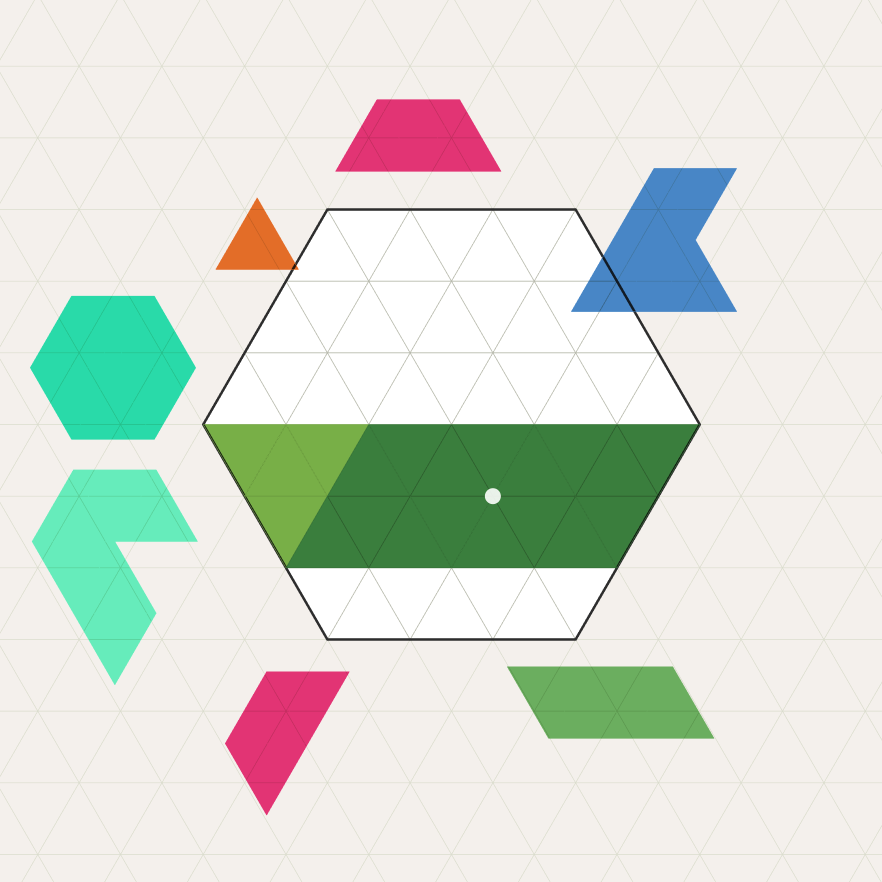
Hexagons are out, though. A square doubled is exactly four squares, and a triangle doubled is exactly four triangles. A doubled hexagon is not made of whole hexagons: it slices straight through its neighbours. Of the three grids that tile a floor, only two can play this game.
Still fighting with bones
Archimedes counted the ways to rebuild a square. Dudeney broke a chessboard, Golomb named the pieces, Pajitnov dropped them from the top of a screen, and a man in Bridlington found a tile nobody thought existed. Each of them changed one rule and found the puzzle still had more to give.
Changing a piece’s size is a small addition to that line, but it is a real one, and it is good to see other designers trying it too. If you want to feel the difference for yourself, there is a new puzzle on the front page every day. It takes a few minutes. Wait for the first time a piece doubles and drops into a gap you had already given up on.
Try the scaling grid
A new Jigsy puzzle every day: free, in your browser, done in a few minutes.
Play today’s puzzle Try Jigsy TrianglesSources
- “Ostomachion”, Wikipedia. en.wikipedia.org/wiki/Ostomachion
- “Stomachion”, Wolfram MathWorld (Bill Cutler’s count of 536). mathworld.wolfram.com/Stomachion.html
- “Tangram”, Wikipedia. en.wikipedia.org/wiki/Tangram
- E. Fox-Epstein and R. Uehara, “The Convex Configurations of ‘Sei Shōnagon Chie no Ita’ and Other Dissection Puzzles”. arxiv.org/abs/1407.1923
- “Pentomino”, Wikipedia. en.wikipedia.org/wiki/Pentomino
- “Martin Gardner”, Wikipedia. en.wikipedia.org/wiki/Martin_Gardner
- “Pentominoes”, Futility Closet. www.futilitycloset.com/2017/01/28/pentominoes/
- “Tetris”, Wikipedia. en.wikipedia.org/wiki/Tetris
- “Soma cube”, Wikipedia. en.wikipedia.org/wiki/Soma_cube
- “Slothouber–Graatsma puzzle” and “Conway puzzle”, Wikipedia. en.wikipedia.org/wiki/Slothouber%E2%80%93Graatsma_puzzle
- “Polyiamond” and “Polyform”, Wikipedia. en.wikipedia.org/wiki/Polyform
- Kate Jones, A Periodic Table of Polyform Puzzles, Kadon Enterprises. www.gamepuzzles.com/PeriodicTableofPolyformPuzzles.pdf
- Abaroth’s World: Puzzles. abarothsworld.com/Puzzles.htm
- “Eternity puzzle”, Wikipedia. en.wikipedia.org/wiki/Eternity_puzzle
- D. E. Knuth, “Dancing Links” (2000). arxiv.org/abs/cs/0011047
- Jaap Scherphuis, PolyForm Puzzle Solver. www.jaapsch.net/puzzles/polysolver.htm
- “Hobbyist Finds Math’s Elusive ‘Einstein’ Tile”, Quanta Magazine, 2023. www.quantamagazine.org/hobbyist-finds-maths-elusive-einstein-tile-20230404/
- “Fillomino”, Wikipedia. en.wikipedia.org/wiki/Fillomino
- Alex Bellos, “The joy of Japanese puzzles”, The Spectator. spectator.com/article/the-joy-of-japanese-puzzles/
- “Shikaku vs LinkedIn Patches — What’s the Difference?”, shikaku.ch; LinkedIn launched its daily games in 2024 (CNN). shikaku.ch/shikaku-vs-patches.html
- Educational Insights, “Kanoodle”. www.educationalinsights.com/item-kanoodle-game
- “The Rise of Kanoodle on TikTok Says a Lot About Puzzle Communities”, Passionfruit. passionfru.it/kanoodle-puzzle-tiktok-12686/
- “Rubik’s Cube Gridlock Game”, Eureka Puzzles. eurekapuzzles.com/products/rubik-s-cube-gridlock-game
- “Rep-tile”, Wikipedia; and David Singmaster’s chronology of recreational mathematics (1749 entry). en.wikipedia.org/wiki/Rep-tile
- “Pentominoes: the Triplication Problem”, CIMT. www.cimt.org.uk/resources/puzzles/pentoes/penttrip.htm
- GMTK Game Jam 2024 entries including scale2fit, Built To Expand and Gridfill. Another, Scale To Build, is a Tetris variant in which oversized pieces can be shrunk to normal size a limited number of times. itch.io/jam/gmtk-2024
- Scaled to Fit by Jonanory (Kenney Jam 2026). jonanory.itch.io/scaled-to-fit
For the long version, with the mathematics left in, see Does It Fit? An evolutionary history of tiling puzzles.